

Key Highlights
- Success can reinforce leadership habits that once worked but no longer serve a changing organisation.
- Authority can reduce the honest feedback executives receive, making it harder to recognise the impact of their behaviour.
- Self-awareness helps leaders notice patterns, manage defensiveness and understand how their actions affect trust and performance.
- Reflection, specific feedback and a willingness to change turn insight into more effective leadership.
Quick Answer
Leadership blind spots are patterns, assumptions or behaviours that senior executives may not recognise in themselves, even when those patterns affect their teams and decisions. They can develop through repeated success, authority, pressure and limited feedback. Self-awareness helps executives understand how they are perceived, examine their reactions and adapt their behaviour. By listening without defensiveness, reflecting on recurring patterns and acting on feedback, leaders can strengthen trust, decision-making and organisational performance.
When Success Makes It Harder to See Yourself Clearly

Senior executives are often promoted because they have delivered results, made difficult decisions or demonstrated confidence when others were uncertain. Over time, those strengths can become central to how they understand themselves as leaders. The problem is not success itself; it is the assumption that the behaviours responsible for earlier success will remain effective in every situation.
A leader who built a reputation for quick decisions may begin to dismiss discussion as unnecessary delay. Someone known for high standards may become so focused on correcting errors that colleagues stop sharing unfinished ideas. An executive who has repeatedly rescued struggling projects may continue stepping in, even when the team needs room to develop its own judgement.
Self-awareness creates the space to question the familiar story a leader tells about their own effectiveness. Instead of asking only whether a decision delivered the intended result, an executive also considers how it was reached, whose input was missing and what the process taught the team. For a broader perspective on the pressures that shape senior leaders, read about the psychological demands of senior leadership.
How Authority Can Narrow a Leader’s Perspective
Authority changes the information that reaches a leader. Employees may soften criticism or avoid disagreement, making it important to compare self-perception with the experiences of colleagues. A structured 360 leadership assessment can provide an additional perspective on strengths, blind spots and leadership impact.
When most conversations are filtered through updates, dashboards and carefully prepared presentations, a senior leader may hear that a strategy is progressing while missing the frustration or uncertainty experienced by the people carrying it out. Silence can be mistaken for agreement, and a lack of challenge can be interpreted as confidence in the decision.
Self-awareness means recognising that position influences the quality of feedback received. Executives cannot assume that people will volunteer every concern. They need to make space for different perspectives and examine whether their own reactions encourage openness or quietly discourage it.
The Difference Between Intent and Impact
Most leaders do not set out to undermine confidence or limit collaboration. An executive may intend to demonstrate urgency but come across as impatient. They may believe they are maintaining quality while colleagues experience constant second-guessing. A leader who sees themselves as direct may not realise that their delivery leaves others reluctant to contribute.
The gap between intent and impact is an important starting point for self-awareness. Leaders need to understand how others experience their communication, rather than relying on good intentions alone. Targeted leadership development programs in Dubai may help translate this awareness into better management conversations and stronger team practices.
Consider a senior leader who regularly interrupts meetings to speed up discussion. In their view, this keeps the team focused. Over time, however, colleagues begin arriving with fewer ideas because they expect to be cut off. The leader may interpret the quieter meetings as improved efficiency, while the organisation loses valuable challenge and insight.
Defensiveness: The Moment Feedback Stops Being Useful
Feedback can challenge a leader’s identity, especially when that identity is based on competence or decisiveness. Under pressure, defensiveness may emerge as explanation, blame or dismissal before listening. Developing the capacity to pause and regulate responses is part of reflective leadership; mental fitness coaching in Dubai is one related area to explore.
These reactions are human, especially under pressure. The risk is what happens next. If every difficult observation is challenged before it is understood, feedback becomes a debate rather than a source of learning. Colleagues may stop raising concerns, and the executive loses access to information that could prevent future problems.
Self-aware leaders learn to create a pause between hearing feedback and responding to it. They can thank the person, ask what they observed and reflect before deciding whether they agree. Listening does not mean accepting every criticism as fact; it means giving the information a fair hearing before reaching a conclusion. A structured 360-degree leadership assessment can also help compare a leader’s self-perception with colleagues’ experiences.
Repeated Behaviour Is Often More Revealing Than a Single Mistake
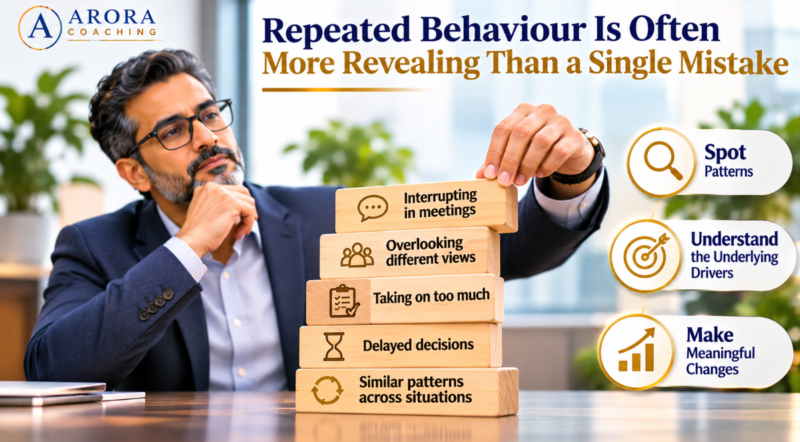
Leadership blind spots rarely appear as one dramatic failure. More often, they emerge through repeated patterns: the same disagreement returning, the same team member becoming disengaged, decisions repeatedly escalating to the executive or meetings ending without genuine commitment. A single incident can have many explanations; a recurring pattern deserves closer attention.
Executives can examine these patterns without turning reflection into self-criticism. The aim is not to label themselves as controlling, impatient or unapproachable. Labels can make behaviour feel fixed. Instead, leaders can investigate what tends to happen before a reaction, what they do in the moment and what consequences follow.
For example, an executive may notice that they become unusually directive when deadlines are threatened. That response might help in a genuine crisis, but if it happens whenever uncertainty rises, the team may learn to wait for instructions rather than solve problems. Recognising the trigger makes it possible to choose a different response: clarify the outcome, identify the risk and let the responsible person propose a way forward.
Turning Self-Awareness Into Better Performance
Insight is useful when it changes what leaders do. Small adjustments to delegation, communication and decision-making can create observable improvements. When the same patterns appear across multiple teams, organisational consultancy in Dubai may be relevant alongside individual leadership development.
One starting point is to seek feedback about a specific behaviour rather than asking broad questions such as whether people think the leader is effective. A more useful question might be, “What do I do in meetings that makes it easier or harder for you to contribute?” Specific questions produce examples that can be considered and acted on.
Finally, change needs observable evidence. A leader who wants to become more open to challenge can track whether they invite dissent before deciding, interrupt less often and follow up on concerns raised by colleagues. Someone working on delegation can observe whether decision-making authority is clearer and whether fewer routine issues return unnecessarily to their desk. Progress becomes meaningful when people experience a difference, not merely when the executive feels more reflective.
A Practical Example: From Micromanagement to Shared Ownership
Consider a hypothetical executive whose department consistently meets deadlines but depends heavily on their personal approval. The executive believes close involvement protects quality. Team members, however, delay decisions while waiting for feedback, and managers become cautious about taking responsibility for complex work.
After receiving feedback that routine decisions are moving too slowly, the executive initially explains that the team needs stronger standards. On reflection, they recognise a recurring pattern: when a proposal differs from their preferred approach, they tend to rewrite it rather than discuss the reasoning behind it. Their intention is to protect quality, but the impact is reduced confidence and slower execution.
The executive begins setting clearer outcomes and decision boundaries, asking managers to explain their recommendations before offering a view and reserving direct intervention for decisions involving significant risk. They also invite the team to flag situations in which approval requirements are unclear.
How Executive Coaching Can Support Reflective Leadership
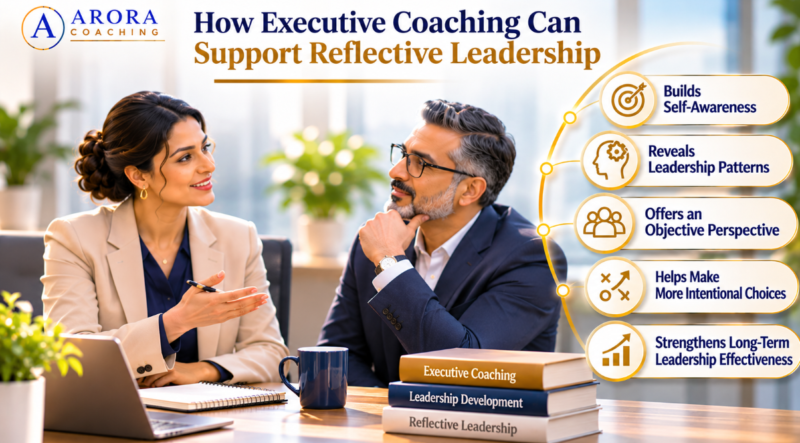
Senior leaders may find it difficult to examine their own behaviour while managing competing priorities and high expectations. Coaching offers a structured opportunity to explore recurring situations, consider feedback and test alternative responses. For leaders seeking this support, explore executive coaching in the UAE. Coaching can complement organisational processes without replacing them.
For executives seeking greater self-awareness, the starting point is to examine familiar situations with fresh curiosity and commit to a practical behaviour change. To discuss whether a coaching approach aligns with those goals, contact Arora Coaching. Specific programme details and suitability should be confirmed during an enquiry.
Frequently Asked Questions
What are leadership blind spots?
Leadership blind spots are behaviours, assumptions or patterns that a leader does not fully recognise in themselves, even when those patterns affect colleagues, decisions or results.
Why do successful executives develop blind spots?
Success can reinforce familiar habits, while authority may reduce the amount of candid feedback a leader receives. As responsibilities change, behaviours that once worked well may have unintended effects.
How can self-awareness improve leadership performance?
Self-awareness helps executives recognise their triggers, understand how their behaviour affects others and make more deliberate choices. This can strengthen communication, trust, decision-making and team ownership.
How can leaders receive feedback without becoming defensive?
They can pause before responding, ask for specific examples, listen to understand the other person’s perspective and reflect before deciding what action to take. Listening does not require agreeing with every observation.
Can executive coaching help identify leadership blind spots?
Depending on the leader’s needs and the coach’s approach, executive coaching can provide structured reflection, help interpret feedback and support practical behaviour changes.
Conclusion: Self-Awareness Is a Leadership Advantage
The leadership blind spots holding senior executives back are often connected to strengths that have become overused, habits that have gone unexamined or feedback that no longer reaches them clearly. Authority and success can make these patterns harder to notice, but they do not make change impossible.
Self-awareness begins when leaders become curious about the difference between what they intend and what others experience. By welcoming specific feedback, examining repeated behaviour and testing small changes, executives can make better decisions and create conditions in which people contribute more openly and take greater ownership.
The goal is not perfect self-knowledge. It is the ability to keep learning as responsibilities, teams and business conditions evolve. A useful question for every senior leader is not simply, “Am I getting results?” but also, “What is my behaviour making possible—or making harder—for the people around me?”