Key Highlights
- Strategic thinking helps executives connect daily decisions with long-term organisational goals.
- Constant firefighting, over-involvement and competing priorities can prevent leaders from focusing on the bigger picture.
- Protected thinking time, scenario planning, delegation and assumption-testing help leaders make more deliberate decisions.
- A small set of strategic priorities, clear ownership and regular reviews turn plans into action.
Quick Answer
Strategic thinking for executives is the ability to look beyond immediate operational demands, assess the wider business environment and make decisions that support the organisation’s long-term direction. Executives can strengthen this skill by protecting time for reflection, connecting initiatives to business goals, preparing for different scenarios, challenging assumptions and empowering teams to own appropriate decisions.
The Shift From Managing Today to Shaping Tomorrow
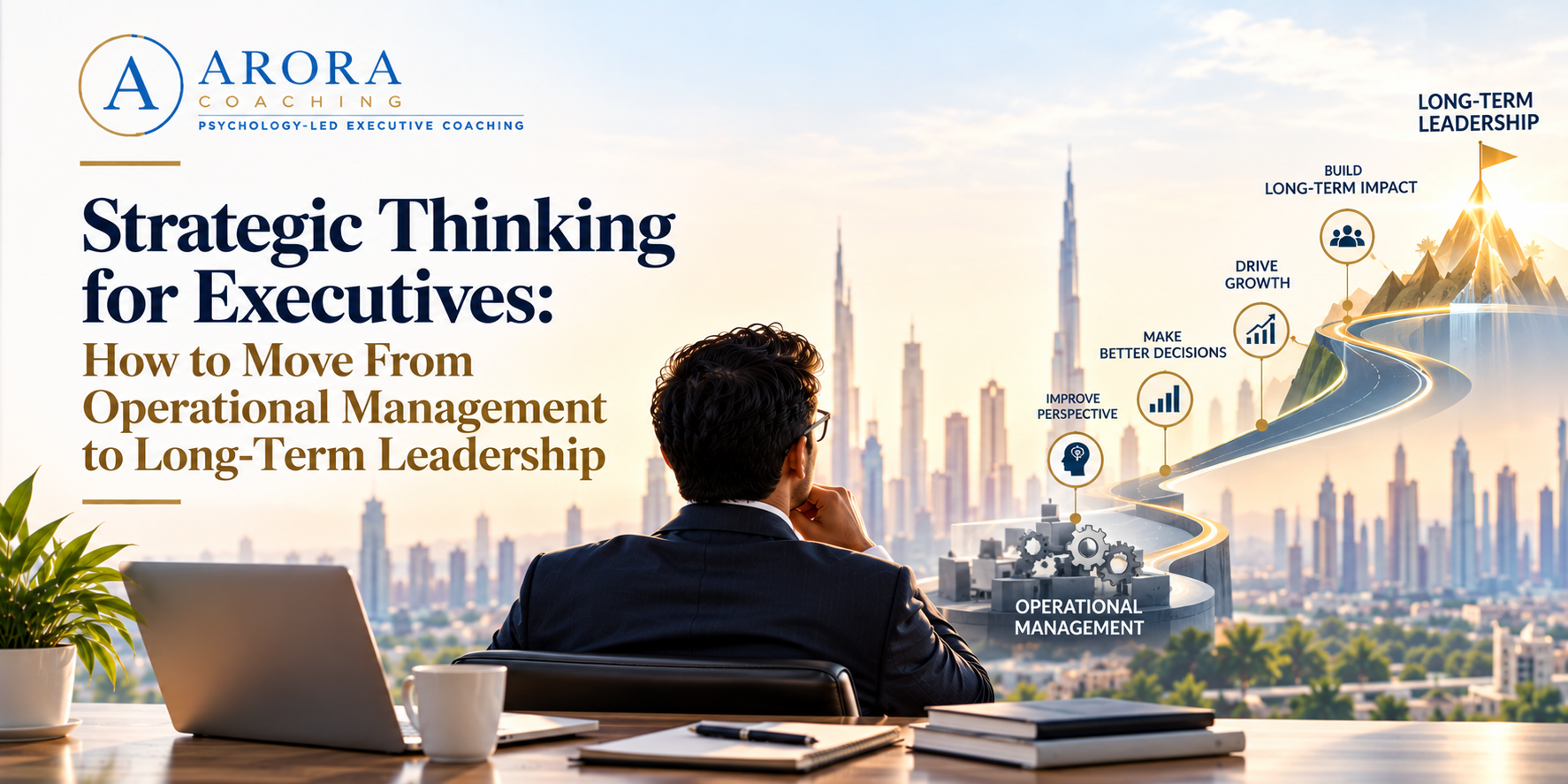
As organisations grow, the expectations placed on their executives change. Leaders who once succeeded by managing daily operations, resolving immediate problems and ensuring tasks were completed on time are increasingly expected to anticipate change, identify growth opportunities, align teams and make decisions that support long-term business goals.
Yet many senior leaders remain closely involved in solving immediate problems. Operational expertise is valuable, but constant firefighting can leave little time to evaluate risks, consider new opportunities or determine whether the organisation is moving in the right direction. Strategic thinking helps executives balance current performance with future priorities.
The goal is not to abandon operational management. It is to recognise when to intervene, when to delegate and when to step back to assess the wider business context.
What Is Strategic Thinking for Executives?
Strategic thinking is the ability to connect an organisation’s current position with its future objectives and identify the decisions needed to move between them. It requires leaders to consider market conditions, customer needs, financial priorities, organisational capabilities and potential risks—not only the performance of individual teams.
Operational management asks whether projects are on schedule, targets are being met and immediate problems are being resolved. Strategic thinking asks whether the right objectives are being pursued, which opportunities deserve investment, what could change in the market and whether today’s decisions strengthen the organisation’s long-term position. Both perspectives matter: operations help the business run effectively, while strategy helps ensure that the work supports the right direction.
Why Executives Can Get Stuck in Operational Thinking?
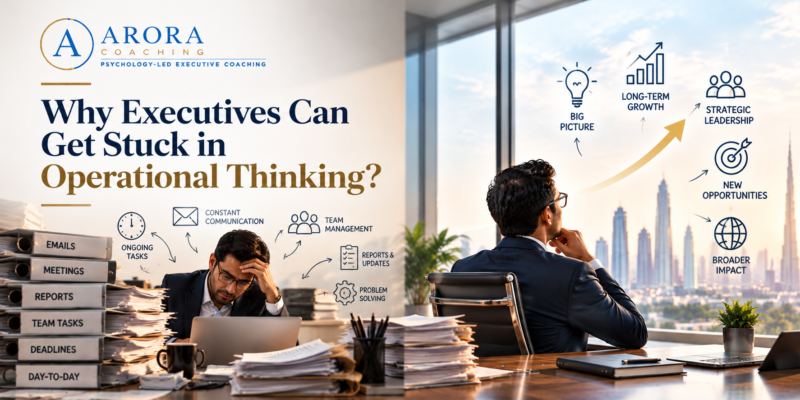
1. Constant firefighting
Urgent issues such as delayed projects, customer concerns or staffing gaps can demand immediate attention. However, repeatedly solving the same problems may hide deeper causes, including unclear ownership, weak processes or insufficient resources. Strategic leaders distinguish between issues that genuinely require executive intervention and those that can be resolved through better systems or team accountability.
2. Reluctance to delegate
Leaders who built their reputations by solving problems personally may struggle to step back. They may continue approving routine decisions or reviewing minor details, slowing progress and limiting their teams’ development. Effective delegation requires clear outcomes, decision-making boundaries and appropriate accountability—not simply handing over tasks.
3. Competing priorities
Executives must balance financial performance, customer expectations, people development, efficiency and growth. Without clear priorities, every request can appear urgent. Strategic thinking helps leaders compare initiatives against business objectives and weigh their likely value, resource requirements, risks and opportunity costs.
4. Pressure for short-term results
Quarterly targets matter, but an exclusive focus on immediate performance can crowd out investments in leadership capability, technology, succession planning and future growth. Executives need to protect essential long-term priorities while maintaining the short-term performance required to keep the organisation healthy.
Five Practical Ways to Develop Strategic Thinking
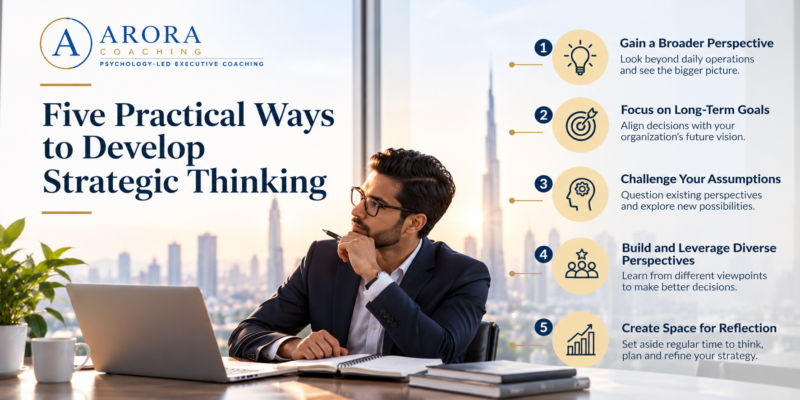
1. Protect time for strategic reflection
Schedule regular time to review business performance, emerging trends, risks and opportunities. Treat this as part of the executive role, not an activity to do only when the calendar is quiet. Useful questions include:
- What are the organisation’s most important challenges over the next 12 months?
- Which activities consume resources without sufficiently supporting our objectives?
- What changes in customer behaviour, technology or competition could affect us?
- Which decisions need attention now to avoid larger problems later?
2. Link decisions to business objectives
A series of individually reasonable projects can still dilute organisational focus. Establish a small number of strategic priorities—such as improving retention, entering a market or strengthening profitability—and assess major initiatives against them. Before committing resources, consider the expected contribution, cost, risk and alignment with the organisation’s direction. This makes it easier to decide what to pursue, postpone or decline.
3. Use scenario planning
The future rarely follows a single forecast. When evaluating an expansion, leaders can consider expected growth, slower demand and faster-than-expected demand. Each scenario may have different implications for staffing, investment and service capacity. Identifying assumptions, warning signs and possible responses helps executives prepare for uncertainty without pretending they can predict every outcome. Leaders working through complex decisions may benefit from executive coaching to examine options and strengthen strategic judgement.
4. Challenge assumptions
Experience supports sound judgement, but a strategy that worked in the past may not suit a new market or business environment. Before a major decision, ask what evidence supports the recommendation, which assumptions remain untested, what information could change the decision and what might cause the plan to fail. Constructive disagreement helps leadership teams identify risks early and make more considered choices. Structured feedback, such as a 360 leadership assessment, can help leaders identify blind spots and development priorities.
5. Reflect on leadership behaviour
At the end of each week or month, review how decisions were made and where attention went. Ask which actions created lasting value, where you became involved unnecessarily, what risks or opportunities were missed and what you would approach differently next time. Feedback from colleagues and team members can reveal patterns that are difficult to see independently.
Operational Management vs Strategic Leadership
The distinction is not that one is useful and the other is not. Effective executives need both. The table below can help leaders recognise where their attention is going and where a shift may be needed.
| Area | Operational Management | Strategic Leadership |
| Primary focus | Daily delivery and immediate performance | Long-term direction and sustainable value |
| Typical question | How do we resolve this issue? | Why is this issue recurring, and what should change? |
| Time horizon | Today, this week or this quarter | The next year and beyond, while managing current needs |
| Decision style | Responds to immediate operational needs | Weighs options, assumptions, risks and future effects |
| Team role | May provide direct answers and approvals | Sets direction and enables accountable decisions |
| Success indicators | Delivery, efficiency and short-term targets | Strategic progress, resilience and capability-building |
“The executive’s value is not measured by how many problems they personally solve, but by how clearly they set direction and how effectively they enable others to act.”
— Anil Arora
A Four-Step Framework for Moving From Operations to Strategy
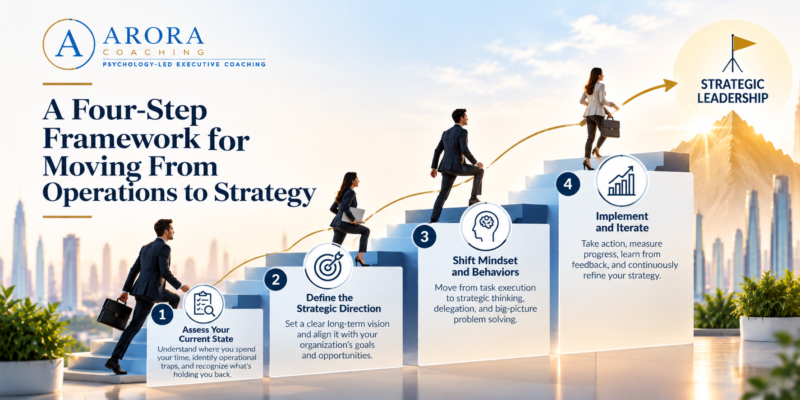
Step 1: Review your time
Track how much time goes to operational problem-solving, routine approvals, people management and future planning. Consider whether this balance reflects your executive responsibilities.
Step 2: Clarify which decisions need you
Identify decisions that genuinely require executive judgement. Delegate routine matters when people have the authority, information and skills to manage them. Retain ownership of decisions involving major risks, organisational direction or competing strategic priorities.
Step 3: Set a few clear priorities
Choose a manageable number of outcomes that matter over the next 12 to 24 months. Assign ownership, milestones and relevant measures so the priorities guide day-to-day decisions rather than remaining abstract ambitions.
Step 4: Review and adapt
Use monthly or quarterly reviews to check progress, challenge assumptions and adjust plans as circumstances change. Strategy should provide direction without preventing the organisation from responding to new information.
A Practical Example: Reducing Dependence on One Executive
Consider a hypothetical senior executive at a growing organisation who continues to approve routine requests, resolve departmental disagreements and oversee minor operational decisions. Major initiatives lose momentum because department heads wait for approval, while future planning is repeatedly postponed.
The executive reviews the situation and identifies unclear decision-making authority, excessive dependence on senior approval and insufficient time for strategic work. The executive then clarifies which decisions department heads can make independently, introduces regular reviews of strategic priorities and reserves time to assess growth opportunities.
The organisation can monitor whether these changes improve decision speed, accountability and progress on important initiatives. The lesson is that increasing organisational complexity does not always require more executive involvement. Clearer systems and empowered teams can free leaders to focus on decisions that need their attention. This is an illustrative example, not a documented Arora Coaching client case; actual results depend on the organisation and implementation.
How Executive Coaching Can Help?
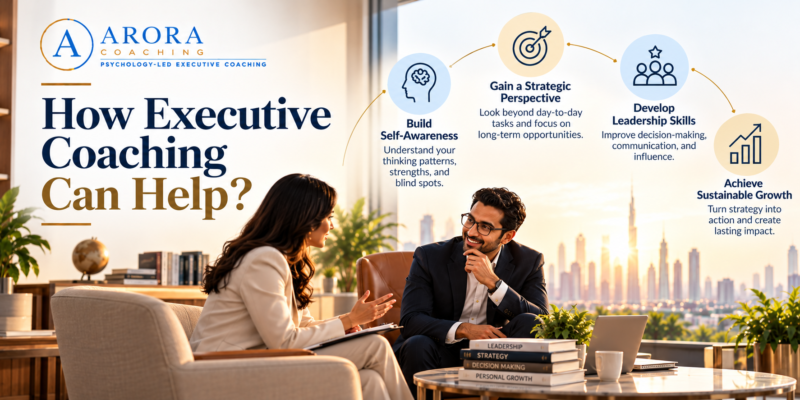
Executives may find it difficult to examine their own leadership habits while managing constant demands. Executive coaching can provide structured space to reflect on decision-making, clarify priorities, consider feedback and identify behaviour changes that support leadership goals. For support with these leadership challenges, explore executive coaching.
For example, a leader who struggles to delegate might explore the assumptions behind that behaviour and consider how to establish clearer decision-making boundaries. An executive preparing for a broader role might examine how to move from functional expertise towards organisation-wide thinking.
Coaching is most useful when it is aligned with the leader’s needs and followed by practical action. It complements—not replaces—business analysis, specialist advice and organisational planning. Arora Coaching’s specific services and methods should be confirmed before describing them in detail.
How to Measure Progress
Executives can assess whether strategic thinking is changing their behaviour and decisions by tracking relevant indicators:
- Time allocation: More consistent time spent on future priorities and risks.
- Decision speed: Fewer unnecessary approval delays for delegated decisions.
- Strategic alignment: Better connection between initiatives, resources and business goals.
- Team accountability: Clearer ownership and fewer recurring operational escalations.
- Execution: More consistent progress against agreed strategic milestones.
Choose measures suited to the organisation and establish a baseline before judging progress. The aim is to improve real decisions and organisational behaviour, not simply to spend more time discussing strategy.
Frequently Asked Questions
What is strategic thinking for executives?
It is the ability to connect current business decisions with long-term objectives, assess risks and opportunities, and determine where the organisation should focus its resources.
Can strategic thinking be learned?
Yes. Leaders can develop it through regular reflection, scenario planning, evidence-based decision-making, feedback and practice connecting daily work with organisational priorities.
How is strategic thinking different from strategic planning?
Strategic thinking involves exploring possibilities, questioning assumptions and understanding the broader context. Strategic planning turns that understanding into defined priorities, actions, ownership and measures.
How can executive coaching support strategic leadership?
Depending on the leader’s needs and the coach’s approach, coaching can help executives reflect on habits, clarify priorities, use feedback and practise more deliberate decision-making.
Conclusion: Move From Managing Activities to Shaping Direction
Strategic thinking for executives is about making deliberate choices that connect current performance with future success. Solving immediate problems remains important, but senior leaders must also anticipate change, challenge assumptions, allocate resources wisely and build teams that can make sound decisions.
Start by protecting time for reflection, connecting initiatives to long-term objectives, preparing for uncertainty, delegating appropriate decisions and reviewing progress. Instead of asking only, “How can I solve more problems?”, ask, “Which decisions and capabilities will create the greatest value for the organisation over time?” That shift in perspective is an important step towards more effective executive leadership.
If you want to strengthen your strategic decision-making and leadership effectiveness, explore Arora Coaching’s executive coaching services to understand what support may be relevant to your goals.